

Let's explore how earth fault protection works in isolated vs. resistance-grounded systems
Earth Fault Protection in solated vs.
Resistance-Grounded Systems
In most electrical networks, the transformer neutral is solidly grounded.
Why? Because when an earth fault occurs on a feeder, a clear path for fault current forms through the neutral.
This allows protection relays ( such as 50N or 50G) to detect and trip the faulted circuit immediately.
However, in some critical networks, the transformer neutral is intentionally isolated to ensure continuity.
With an ungrounded system, a single phase to earth fault doesn't cause an outage ,it keeps operating so maintenance can be planned without unscheduled downtime.
• But here's the key question:
How do we detect an earth fault if there's no neutral current?
The answer lies in voltage transformers (VTs).
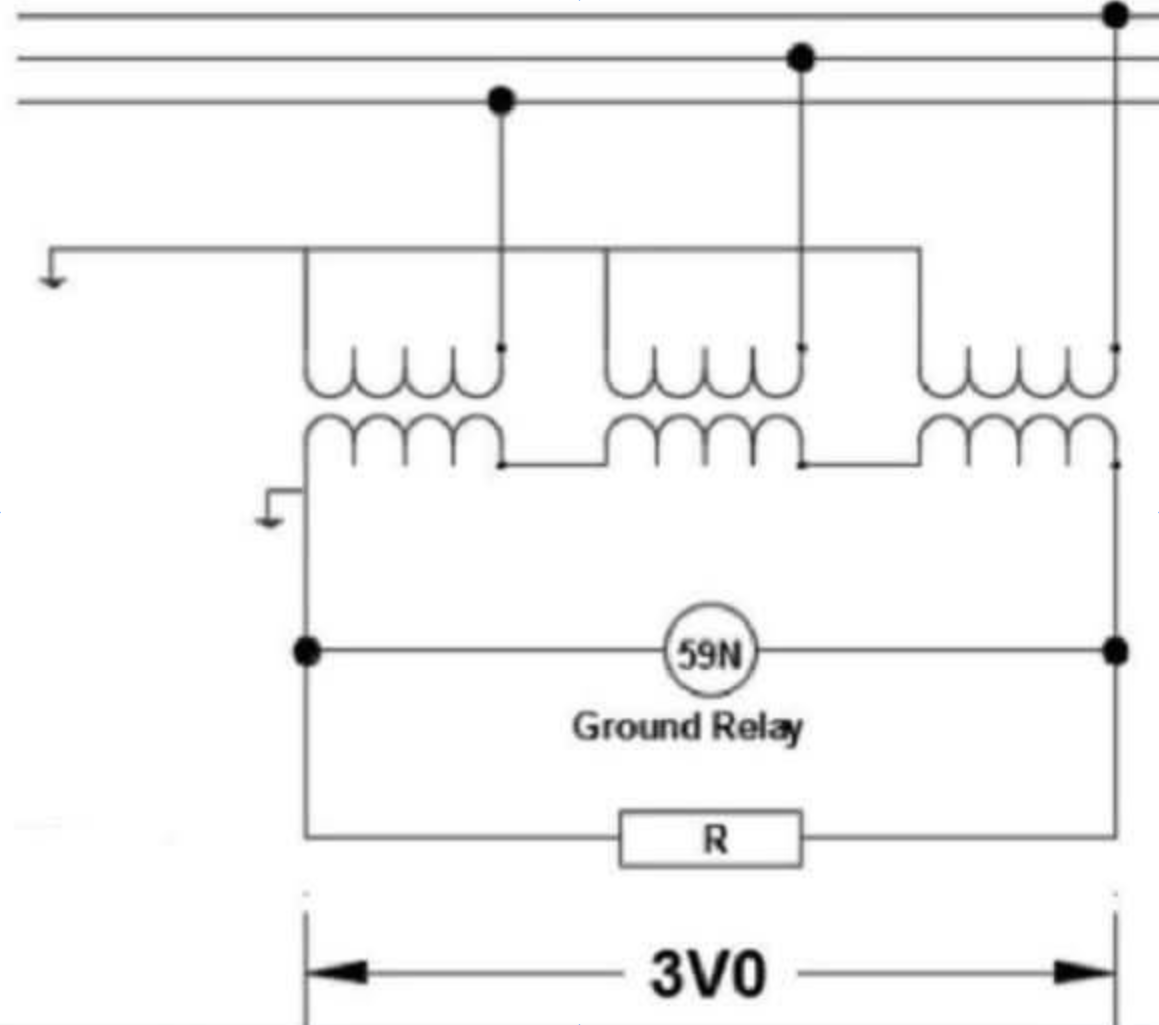
Three VTs are connected in an Open-Delta (V-V) or "Broken Delta" configuration. The output feeds a 59N relay (Neutral Voltage Displacement relay).
● How It Works
• Normal Conditions:
Phase voltages are balanced; the vector sum (Va + Vb + Vc)= 0. The open-delta produces no output, keeping the 59N relay inactive.
• During an Earth Fault:
A fault unbalances voltages, so (Va + Vb + Vc) = 3Vo (zero-sequence voltage). This appears on the open-delta secondary, activating the 59N relay and tripping the
circuit.
In Summary
In ungrounded systems, protection shifts from current measurement to voltage imbalance detection.
Two common methods:
1 • Core Balance CT (CBCT) – detects small residual
currents (mainly capacitive). Often paired with the next
method for reliability.
2 • Neutral Voltage Displacement (59N) -measures zero-sequence voltage via open-delta VT, providing robust fault detection.
System Philosophy
• Solidly Grounded → prioritize immediate clearance
• Isolated... emphasize operational continuity
Choosing the right grounding and protection scheme ensures a reliable and resilient power network.