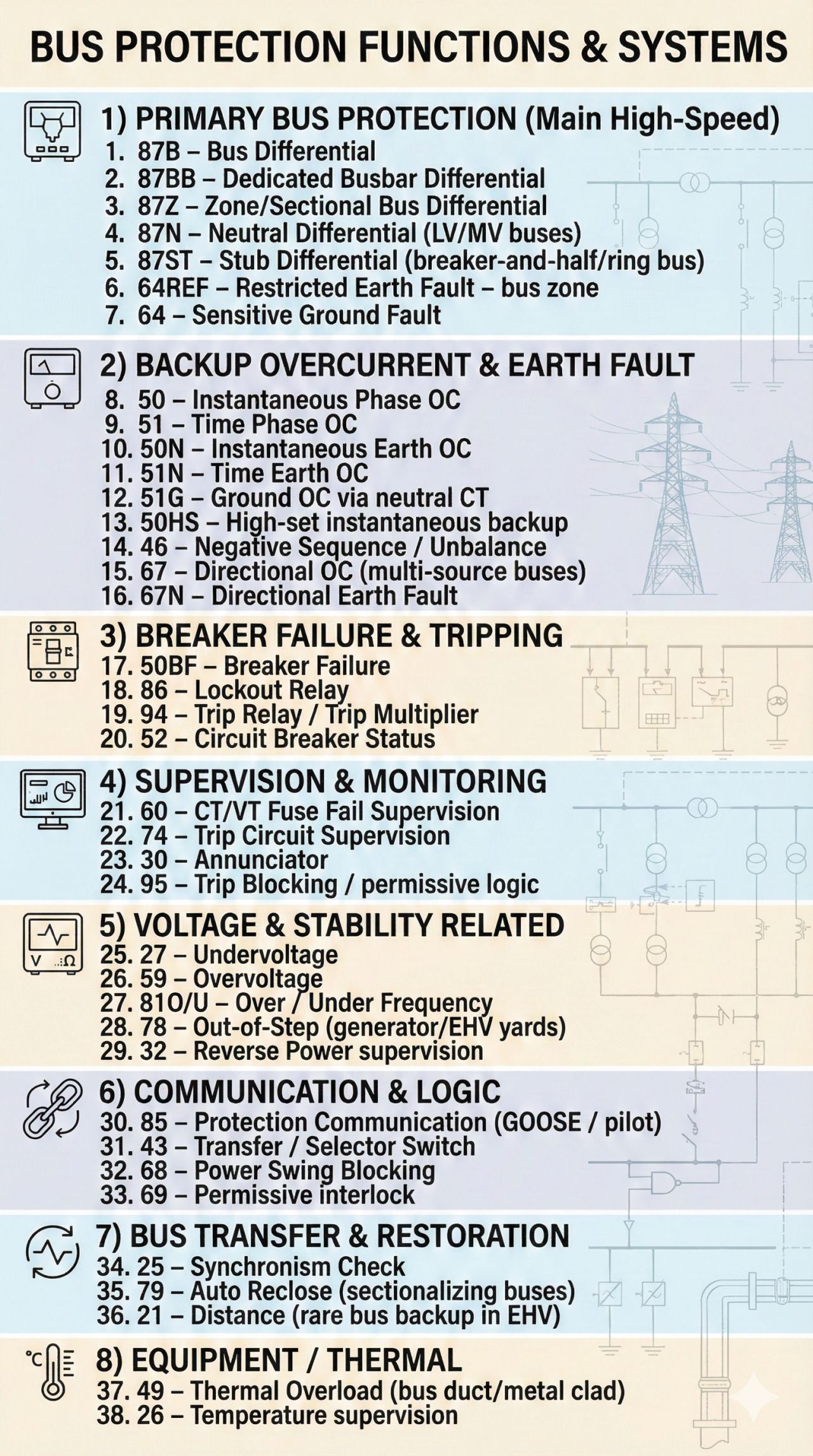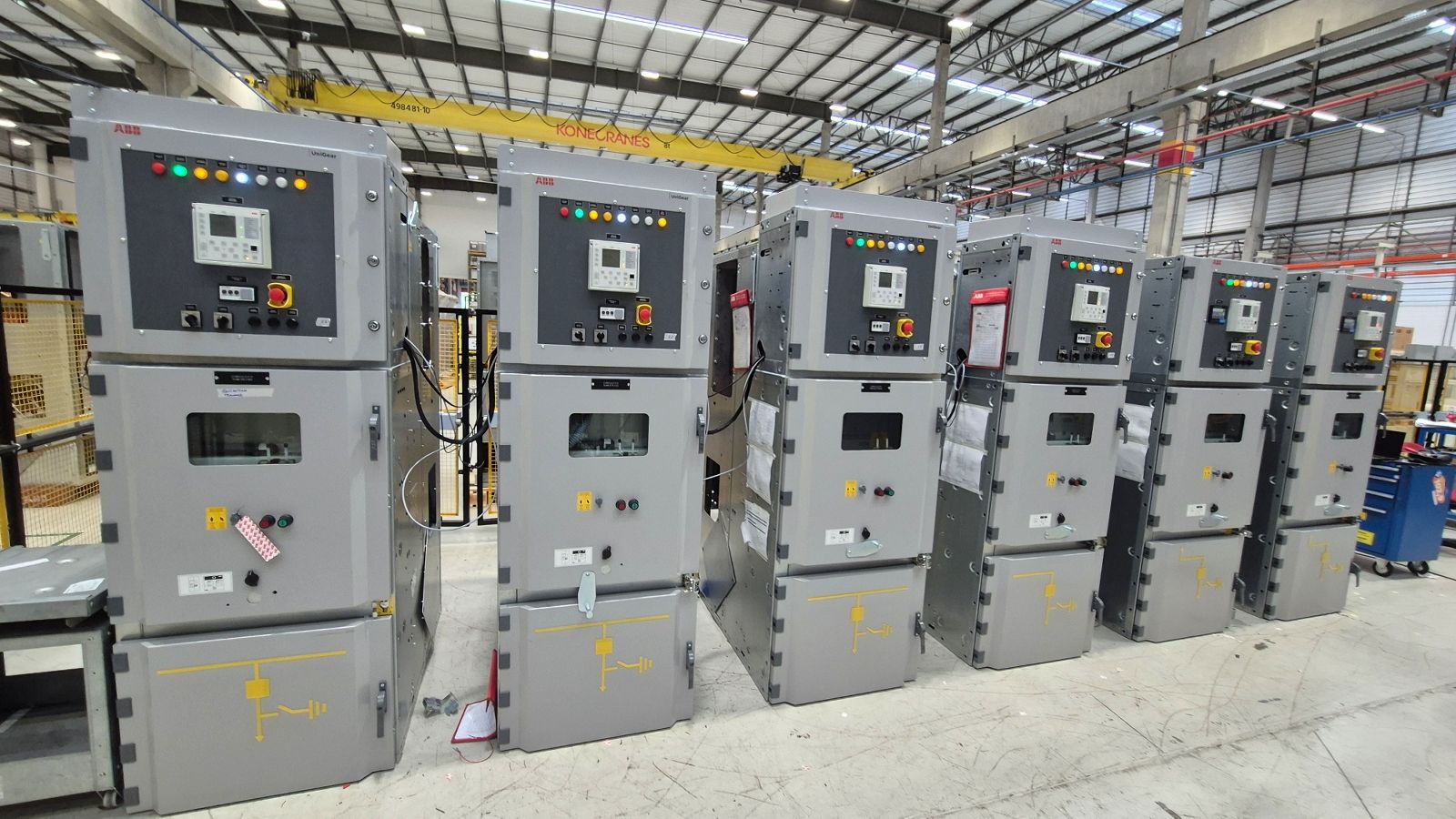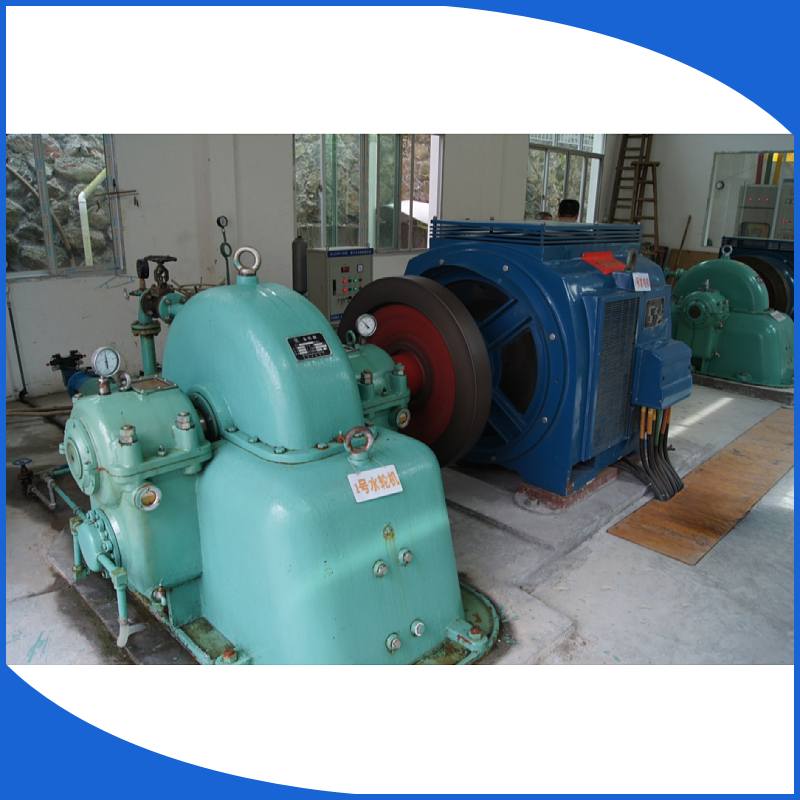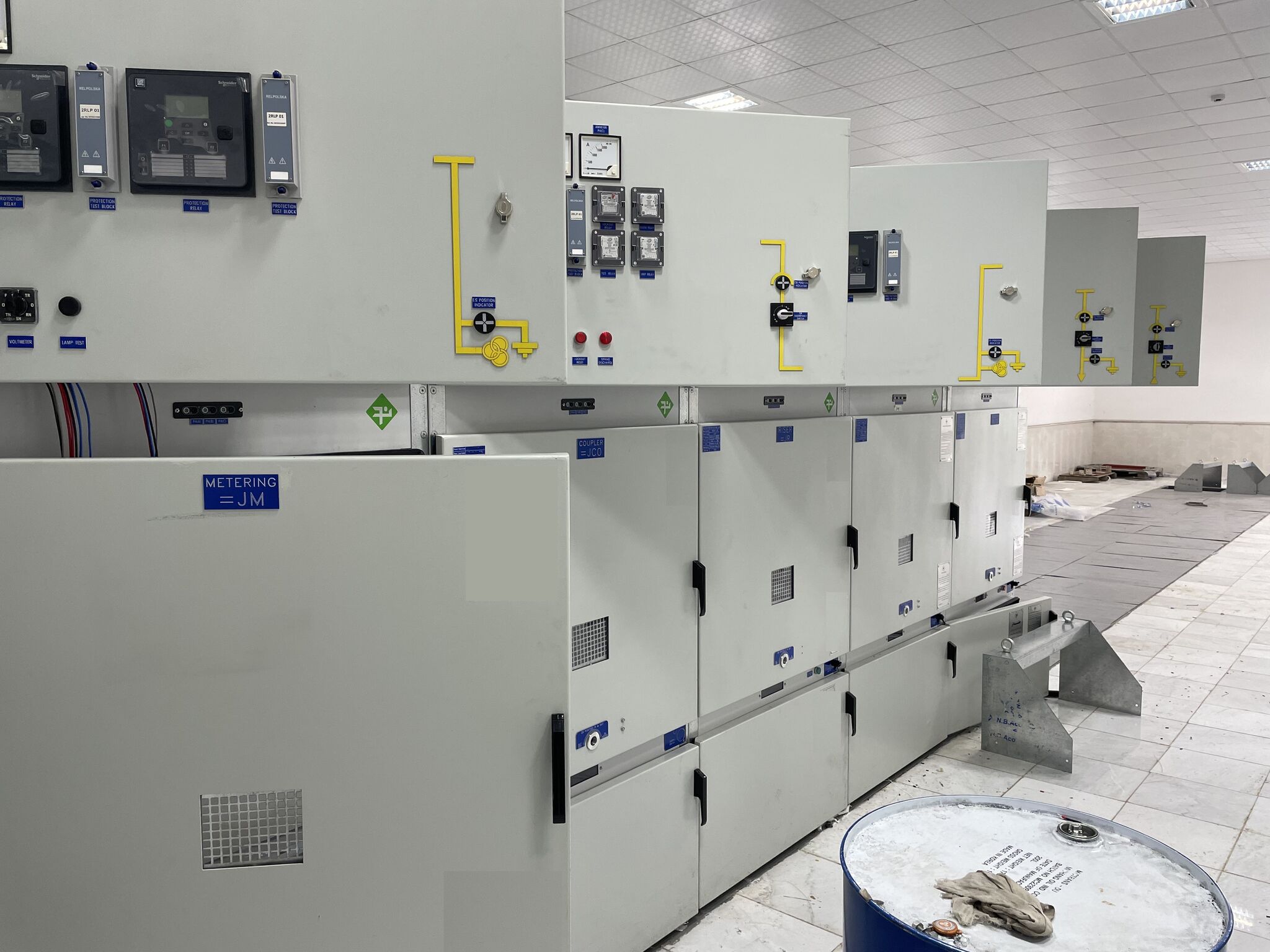


1) Primary Bus Protection (High-Speed – Main)
• 87B – Bus Differential: Compares all feeder currents; trips instantly for internal bus faults.
• 87BB – Dedicated Busbar Diff: Separate relay only for bus zone security.
• 87Z – Zone/Sectional Diff: Protects individual bus sections in double bus systems.
• 87N – Neutral Differential: Used in LV/MV grounded buses.
• 87ST – Stub Diff: Protects breaker-and-half / ring bus dead zones.
• 64REF – Restricted EF: Highly sensitive earth fault inside bus zone.
• 64 – Sensitive GF: Detects very low ground currents.
👉 These are the MAIN FAST protections in all substations.
2) Backup Overcurrent & Earth Fault
• 50 – Instant Phase OC: No delay, close-in fault clearing.
• 51 – Time OC: Graded with feeders for coordination.
• 50N / 51N – Instant & Time EF: Earth fault backup.
• 51G – Neutral CT EF: For transformer/bus grounding path.
• 50HS – High-set backup: Last defense for severe faults.
• 46 – Negative Sequence: Unbalance & phase loss.
• 67 / 67N – Directional OC & EF: Needed for multi-source buses.
👉 Used as backup in every scheme.
3) Breaker Failure & Tripping
• 50BF – Breaker Failure: Trips upstream if CB doesn’t open.
• 86 – Lockout: Latches trip for safety.
• 94 – Trip Multiplier: Fan-out trip to many breakers.
• 52 – CB Status: Open/close supervision.
👉 Critical for reliability of any protection system.
4) Supervision & Monitoring
• 60 – CT/VT Fuse Fail: Avoids false trips.
• 74 – Trip Circuit Supervision: Checks coil wiring.
• 30 – Annunciator: Alarm display.
• 95 – Trip Blocking Logic: Interlock safety.
👉 Operational health monitoring.
5) Voltage & Stability
• 27 – Undervoltage
• 59 – Overvoltage
• 81O/U – Frequency
• 78 – Out-of-Step
• 32 – Reverse Power
👉 Grid stability protections.
6) Communication & Logic
• 85 – GOOSE/Pilot communication
• 43 – Selector switch
• 68 – Power swing block
• 69 – Permissive interlock
👉 IEC-61850 based modern schemes.
7) Bus Transfer & Restoration
• 25 – Sync check
• 79 – Auto reclose
• 21 – Distance backup (EHV)
8) Equipment / Thermal
• 49 – Thermal overload
• 26 – Temperature supervision