


Understanding 27C Voltage Function Protection: Undervoltage with Conditional Current Supervision
In the world of power system protection, an undervoltage condition (ANSI code 27) is a critical event. However, a simple undervoltage relay can often be too sensitive. It may trip unnecessarily during temporary voltage dips, or worse, when a line is intentionally de-energized.
To solve this, modern protective relays use a more advanced logic: 27C Voltage Function Protection. This article breaks down how this function works, its logic, and why it is crucial for industrial and utility applications.
What is 27C Protection?
The "C" in 27C stands for Conditional Supervision. Unlike a standard 27 undervoltage element, the 27C function requires a secondary condition to be met before it issues a trip signal.
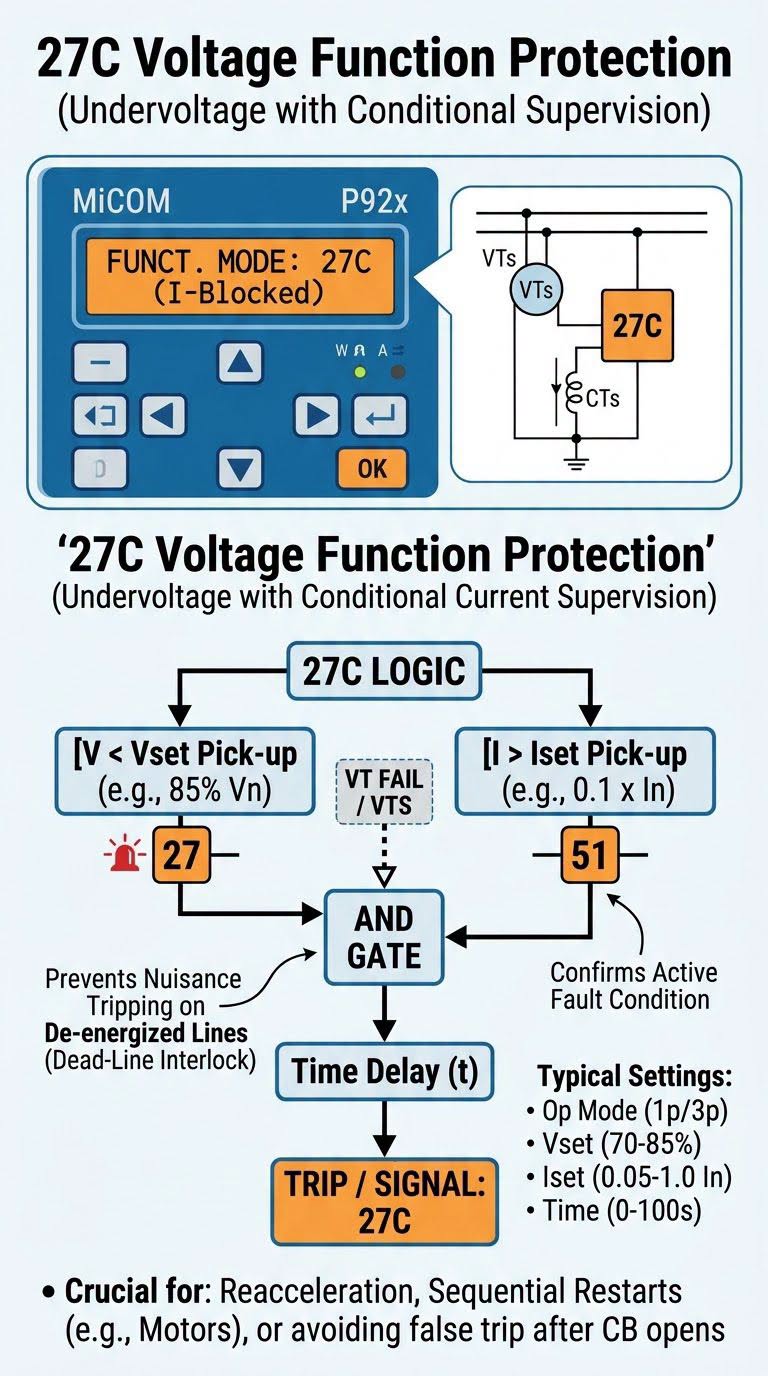
As shown in the logic diagram, the 27C function uses an AND Gate. This means two conditions must be true simultaneously to trigger a trip:
The Voltage Condition: The measured voltage (V) must drop below a set pickup value (Vset).
The Current Condition: The measured current (I) must exceed a set pickup value (Iset).
In the example provided, the relay trips only if the voltage drops below 85% of the nominal voltage (Vn) AND the current exceeds 0.1 times the nominal current (In).
The Logic Explained
The infographic illustrates a clear sequence:
Voltage Element (27): Monitors the system voltage. If it falls below the threshold (e.g., 85% Vn), it picks up.
Current Element (51): Monitors the current. If it rises above the threshold (e.g., 0.1 x In), it picks up.
The AND Gate: This is the core of the "Conditional Supervision." It only allows a signal to pass if both the 27 and 51 elements are picked up.
Time Delay (t): A settable delay (e.g., 0 to 100 seconds) is applied to prevent tripping on transient voltage sags.
Trip/Signal: If all conditions are met for the set duration, the relay issues a trip command.
Why is Conditional Current Supervision Important?
The primary purpose of adding current supervision to an undervoltage function is to prevent nuisance tripping.
1. Dead-Line Interlock
When a circuit breaker opens, the line becomes de-energized. The voltage drops to zero. A standard undervoltage relay would see this as a fault and try to trip. However, with 27C logic, the current also drops to zero. Because the current is below the pickup setting (e.g., 0.1 In), the AND gate is not satisfied, and the relay blocks the trip. This is known as Dead-Line Interlock.
2. Confirming Active Fault Conditions
If the voltage drops while current is still flowing, it indicates a genuine fault condition (like a short circuit or a heavy overload causing a voltage collapse). The presence of current confirms that the line is still energized and that the undervoltage is a real problem, not just a disconnected line.
3. Avoiding False Trips After Breaker Operations
After a breaker opens, there can be residual voltages or induced voltages from parallel lines. The current supervision ensures the relay doesn't misinterpret these conditions as a live fault.
Typical Settings and Applications
The infographic highlights several key settings:
Op Mode (1p/3p): Single-phase or three-phase operation.
Vset: Typically set between 70% and 85% of the nominal voltage.
Iset: Typically set between 0.05 and 1.0 times the nominal current.
Time (t): Adjustable from 0 to 100 seconds.
This function is crucial for:
Reacceleration: Restarting motors after a voltage dip.
Sequential Restarts: Ensuring motors don't restart all at once, which could cause a system overload.
Motor Protection: Preventing motors from running at dangerously low voltages.
Conclusion
The 27C Voltage Function Protection is a sophisticated logic that combines voltage and current measurements to make smarter tripping decisions. By requiring both undervoltage and overcurrent conditions to be met, it provides a robust defense against nuisance trips while ensuring genuine faults are cleared quickly. For engineers designing protection schemes for motors, feeders, or complex industrial processes, understanding and correctly setting the 27C function is essential for system reliability.