



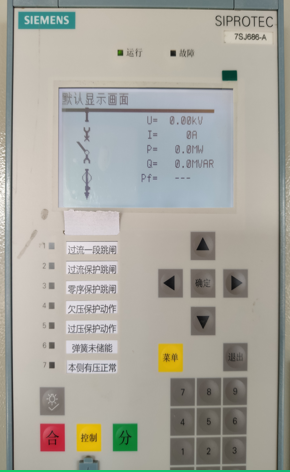
When electric motor units are operating they may experience overloading, phase loss, stalling, short circuits, overvoltage, undervoltage, or leakage currents. In cases of three–phase imbalance , overheating, bearing wear, or stator–rotor misalignment, an alarm or protection mechanism is triggered; therefore, the device that provides protection for an electric motor is the Siemens microcomputer–based protection system.
1. Instantaneous current cutoff protection
Motor stator winding phase short circuit protection, generally used for the motor below 2000kW, action in tripping.
2. Transverse differential protection
When the sensitivity of the current breaker protection for an electric motor of 2000KW and above, or for an electric vehicle of less than 2000kW, does not meet the requirements, differential protection is used to protect the internal and differential short circuit of the electric motor and the inductance line, and the action is to jump.
3. Overload protection
To prevent the excessive current caused by the overload of the production machinery to be dragged by the electric motor, move to the signal or move to the brake with a certain time limit.
4. Single–phase ground fault protection
In a small earthing current system, when the earthing current is greater than 5A, in order to prevent the danger of single-phase earthing failure of the current motor's stator circle, single-phase grounding protection must be installed. When the earthingcurrent value is 5A ~ 10A, the signal is moved; When the grounding current is greater than 10 A, the action is tripped. After a single-phase ground failure of a high-voltage electric motor, it is not necessary to remove it. Because the single contactor of the motor is a protection for the operation of the motor, the simple failure of the single contactory of the motor does not affect the normal operation of the electric motor, but cannot be done to protect the electric leakage, so as long as the motor is working normally, it does not have to be removed immediately. However, if there is already electricity inside the motor, do not put it into operation, for reasons of safety, and to easily further burn the motor.
5. Low voltage protection
Protection to prevent the voltage from decreasing or to interrupt the motor's self-starting operates by a brake and can be installed as needed.
6. Electric motor Rotor stall protection
Brake protection protects the motor during operation. When the motor accidentally shuts down the rotor due to overload operation, the brake protection quickly acts to shut down the motor to avoid or reduce damage to the drive, bearings and other motor components. This protection function is automatically put into action after the motor is started.
The motor rotor block protection provides two phases of time-limited overflow elements, each of which can be individually fixed. The phase 2 time limit overcurrent element compares the current in the sequence after the motor is started with the fixed overcurrent start value, and when the current in sequence exceeds the fixed value, a start signal is given. After the delay time set by the user arrives, if the lock is not detected, a blocking signal is issued.For positive sequence current values > 0.2 In, the return value is approximately 95% of the start value.
7. Motor under–current protection
When the current of the three phases of the wind-cooled motor is below the current fixed value, low flow protection is initiated, and an alarm signal is sent during a fixed delay. When the wind-cooled motor stops, a lack of flow warns.
8. Negative sequence overcurrent protection
The negative–sequence overcurrent protection function of an electric motor protector is used to detect negative–sequence currents that arise in an electric motor system due to asymmetric faults or asymmetric loads。When a negative-sequence current flows over the stator circle of a three-phase induction motor, a reversed electromagnetic field is generated, expressed as a 2 times frequency current of the rotor, causing a vortex to be sensed on the surface of the rotation, causing overheating of the ends and edges of the shaft. If the negative sequence current exceeds the ability of the motor to withstand the negative series current, the rotor will overheat, thereby endangering the safe operation of the motor. Negative-order overflow protection provides two phases of fixed-time limit overflow and one phase of counter-time limitoverflow, each of which can be fixed individually.The negative sequence overcurrent protection operating level offers an analog channel option, allowing you to select either protection CTs or measurements。CT 。
9. The motor starts monitoring
The motor start monitoring function provides protection to the motor during the motor start, supplementing the heat overload protection to prevent the motor from starting for too long. If the duration of the start of the motor is prolonged due to a drop in the voltage when the motor starts, or excessive load torque, rotor blockage, etc., the device can output a brake signal to protect the motor.
When an electric motor is switched on, it generates a surge current; when the motor’s startup monitoring feature is activated,The device determines whether an electric motor is in a startup state based on changes in the motor’s current, and sends a message indicating that the motor is starting up ; the logic for determining whether a motor is in a startup state is as follows:
The criterion for starting the motor is that the maximum phase current of the motor changes from zero to 0.1 times the frontal current of the motor within 20 ms.
Motor start process return criterion: motor maximum phase current continuous 40ms less than 1.1 times the motor frontal current.
10. The motor restarts the suppression
In the case of electric motor rated operation and load increase, the rotor temperature of the electric motor is generally maintained below its maximum permissible temperature. However, the large starting current required during motor startup increases the risk of rotor damage due to overheating, while this risk does not exist for the stator, due to the rotor's low thermal constant. In order to avoid a jump-off caused by multiple starts, if the temperature of the rotor significantly exceeds the thermal limit of the rotation during the start, the motor must be prohibited from being restarted. The shutdown signal must be transmitted to a protected switching output device whose points are connected to the motor start circuit.
The motor restart inhibition feature functions during the startup process of a stopped motor。When the motor’s three–phase current drops to a set value Circuit breaker closed–position current criterion Under these conditions, the motor is considered to be in a stopped state; when any phase current of the motor exceeds the circuit breaker closed–position current criterion , the motor is considered to have entered a restart phase, and the restart suppression mechanism automatically begins operating。Therefore, current criterion for breaker closure position The set value should be lower than the motor’s no–load current.
11. Electric motor electromagnetic protection
Motor demagnetization protection is a protection function specifically designed for synchronous motors. When the synchronous motor loses or is insufficiently energized, the motor will lose its ability to operate in synchrony, causing changes in electrical quantity such as current, voltage and power factor. Magnetic protection By monitoring changes in these electrical volumes, it is possible to detect and treat magnetic failures in a timely manner, protecting the electric motor from damage.
The electromagnetic protection of electric motors usually consists of two parts: step protection and failure protection. Step protection is used to detect the stepless state of the synchronous motor. When a step is detected, the protection acts to jump the brake to prevent the motor from continuing to operate in the stepless condition. Power failure protection is used to monitor the magnetic state of the synchronous motor, and when the magnetic is insufficient, the protection sends an alarm signal or acts to jump the brake to prevent the motor from being damaged due to power failure.
12. Overheating protection for electric motors
Overheating protection of motors is the protection of the motor by monitoring the temperature of the motor. When the motor is operated for a long time or is overloaded, the temperature of the motor will increase, and if measures are not taken in time, it may cause the motor to burn. Overheating protection monitors the temperature of the motor in real time by a temperature sensor installed on the motor. When the temperature exceeds the set value, the protection acts by jumping the brake or issuing an alarm signal to alert the operator to take steps to reduce the temperature of this motor.
In addition, the overheating protection of the motor can also be used in conjunction with other protection functions of the motor to form a complete motor protection system. For example, when a single-phase ground failure occurs in an electric motor, if not treated in time, it may cause a short circuit inside the motor, causing an increase in the motor temperature. At this time, single-contact protection and overheating protection can cooperate with each other to jointly protect the safe operation of the electric motor.
In summary, the microscopic protection device provides comprehensive protection for the electric motor, These include current shutdown protection, longitudinal differential protection, overload protection, single-phase protection, low voltage protection, rotor blocking protection, low flow protection, negative sequence overflow protection, start monitoring, restart suppression, and magnetic loss protection and overheating protection. These protection functions can effectively prevent and treat various faults and abnormalities that may occur during the operation of the electric motor, ensuring the safe and stable operation of the motor.